 |
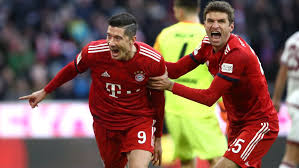
| Bayern Munich's Robert Lewandowski (9) and Thomas Muller (25) celebrate a goal |
We, as sports fans, have been wandering aimlessly in the Sinai Desert for the last forty years, with no new sporting content. Okay, maybe it’s only been two months, but it feels like forty years. We have sadly subsisted on manna in the form of the NFL Draft-a-thon, classic games, The Last Dance, and *sigh* televised H-O-R-S-E. But, at last, sports are beginning to return. The Korean Baseball Organization returned this week, the MLB is gearing up for an epic labor battle, and the German government has returned like Moses, strolling down from the Mount with The Eleven Page Plan for Playing Soccer Again. That’s right--the Bundesliga is back next Saturday, and we will once again have high level sports to distract us.
There’s just one small problem; it’s German soccer, and many Americans are not too familiar with the dynamic players, why Bayern always wins and why everybody hates RB Leipzig. So, I shall take it as my duty to be your American liason for the beautiful game’s German branch.
Why are they coming back so early?
Germany has one of the lowest infection rates among the major Western European countries, and began slowly reopening the country in late April. The Bundesliga and Bundesliga 2 (the country’s top two divisions) had players return to isolated training in early April as states allowed.
The league is also returning out of a pure need for cash. If all remaining matches were canceled, it’s estimated the top two divisions would collectively lose €800 million ($870 million), and eighteen of the top 36 clubs in the country would be at risk of financial collapse. A Schalke ‘04 executive called that possibility “existence threatening.” Another from Borussia Dortmund stated that “the league would not exist in its current form” if the remaining nine games were called off.
In most countries and sports, franchises are owned by incredibly wealthy men (that often double as cartoonish super villains) or corporations. They might complain about the bottom line, but never seriously risk financial ruin. However, Germany’s footballing body, the DFL, has a rule that specifically states that individuals must own at least 51% of a club in order to field a team in national competitions. This largely prevents teams from being bought by, say, oil sheikhs, and keeps the game in German hands. The main exception is RB Leipzig, which is 49.9% owned by Red Bull and 50.1% owned by Red Bull executives.
This policy is generally a good thing when the world is not on fire. It keeps the game authentic, disinflates transfer prices, and keeps tickets cheap. Unfortunately, the world is currently on fire. Super clubs like Manchester City and Paris Saint-Germain, with their oil money, oil money, and oil money, will be fine, but most German clubs are at risk. Even Dortmund, the second biggest club in the country, had to accept an interest-free loan from rival Bayern less than twenty years ago to stay afloat. Bundesliga clubs need revenue to stay afloat.
Gosh, that’s kind of dark. Are the players ready to play?
Sure. They have been training individually and in small, positional groups for about a month, depending on the team. On May 8, all players went into a weeklong quarantine/training camp at team facilities to prepare for the upcoming season. Before that, teams had been having players watch film and tailoring workouts to individual players and their demands. RB Leipzig installed several 360-degree screens in their facility so that players could work out the soccer parts of their brains.
There are worries, though. Most coaches wanted an extra week of full team training because frankly, eight days is not enough time for even the most elite of athletes to return to game shape. Players, coaches, executives, fans, writers, ballboys, and sentient dogs all predict a rash of injuries in the first two or three weeks of resumed play. In an attempt to counter this, FIFA has green-lighted a temporary law change that would allow teams to use five substitutions per game, instead of the usual three.
Is everyone safe?
Probably? Games will be played behind closed doors (no word on whether KBO style cardboard fans will be used) and fans will be discouraged from gathering. If fans congregate outside of a stadium, the home team will forfeit the match. I see absolutely no way that conniving supporters will abuse this rule. A maximum of 322 people will be allowed in the stadium on matchday, including players, coaches, officials, replay operators, broadcast crew (gotta get that TV money somehow), security, medical staff, and ‘hygiene officers.’
Players and officials will be tested twice a week, with the DFL paying for all tests and not taking any away from the public. Players will not be allowed to unnecessarily touch teammates or spit on the ground to curb transmission of the virus, but there are concerns because soccer is, famously, a contact sport.
Wait, does that mean players can’t celebrate a back post tap-in with incredible theatrics?
Sadly. No high fives. No elaborately choreographed group celebrations. What has this world come to?
Okay, okay. Why should I care about this anyway?
Well, the Bundesliga is the second best soccer league in the world, after the English Premier League. They boast high quality teams that compete in European competition (three teams in the Champions League Round of 16, tied with Italy and behind England and Spain) and incredible balance between teams throughout the top division (eight points separate first and and fifth, eleven points separate the next eleven).
But why should I care as an American?
As a true American, you shouldn’t care about soccer at all, obviously. Nerd. But for those true patriots who do care, the Bundesliga is ripe with young US talent. Ripe, I tell you. While wunderkind Christian Pulisic is gone, five of the US Men’s National Team’s best XI still play in Germany. So does their top youngster.
Leading the way are Texan and Schalke center midfielder Weston McKinnie and North America’s top goalie, Zach Steffen, on loan at Fortuna Dusseldorf. McKennie has forced his way into a starting role at the base of Schalke’s midfield, and has provided solid passing and defense, but only has one goal to his name in each of the last two seasons. Steffen has been unspectacular, allowing 2.12 goals per game on a team in a relegation battle, but he still shows signs of stepping into Timmy Howard’s #1 jersey.
Elsewhere, John Brooks, scorer of the greatest goal I’ve ever seen live, has stayed immovable as ever at the back for a Wolfsburg squad that has allowed a measly 30 goals in 25 games. Tyler Adams has made a few cameos for RB Leipzig as they chase a title for eastern Germany, and Josh Sargent is averaging over half a goal + assist per minute as a super sub for relegation-threatened Werder Bremen.
The most exciting American in Germany, though, is Gio Reyna of Dortmund. At seventeen, he broke into a BVB Dortmund team famous for its youth development and has played a whole eight Bundesliga minutes. And he’s eight months younger than me. Oof. Age related bitterness aside, Reyna has shown fantastic touch and scoring ability in the eleven minutes he’s played for the club through all competitions, including a gorgeous winner against Werder Bremen that made him the youngest scorer in German Cup History. The future of America rests in Germany.
Wow. Where can I watch these guys?
FOX, FS1, FS2, etc. And don’t worry--Joe Buck will not be in the booth for any of these. Yes, your ears are safe and no, FOX did not pay me to say this.
Who are the most exciting non-American players?
Bayern Munich’s trusted combination of striker Robert Lewandowski and mid Thomas Muller are once again wiping the floor with any and all comers (they're so good they have fanfiction). Lewandowski has 25 goals and 3 assists in 23 games, and Muller has an outrageous 16 assists in 18 matches. English youngster Jadon Sancho has been devastating on the wing for Dortmund, registering 14 goals and 15 set-ups for the dynamic strike force of Marco Reus and Erling Haaland.
Haaland has a claim as the best teenager in Europe. He has netted an epic UCL hat-trick for RB Salzburg in the fall and scored 8 goals in the group stage of the competition before moving to Dortmund. Between the two clubs, Haaland has scored 41 goals in just 29 games, a blistering clip. He doesn’t turn twenty until July either. His game is a combination of sizzling skill, NBA size (6-4, 190, looks like a 90’s movie villain), and shots so powerful that they make music. He has the potential to challenge Kylian Mbappe for the title of best under-21 in the world, and he’s a huge reason you should be watching the Bundesliga.
Why does everyone hate RB Leipzig?
Imagine if the Steinbrenner era Yankees spawned fully formed in 2015 and lured top prospects to their organization. And they had minimal fan support, but every fan was just...you know...a typical sneering Yankee fan (offense intended). As previously mentioned, Red Bull used some shady tactics to acquire a controlling stake in RB Leipzig in 2009. They started in the German Fifth Division, playing outrageously nice digs for a club that low on the ladder and using corporate money to acquire and develop Europe’s best young talent.
Their fans are...sparse, yet annoying. German feels it has a culture of not allowing corporate money into soccer, despite Volkswagen and Bayer Pharmaceuticals owning Wolfsburg and Bayer Leverkusen, respectively. Therefore, every club in Germany (and I mean EVERY club) considers Leipzig their rival, leading to general hooliganism usually reserved for real rivalries. Frankly, the energy drink giants couldn’t care less, and RB sits third in the table, five points behind Bayern in first.
Speaking of the table, who’s gonna win this thing?
Grass is green, the sky is blue, politicians lie, and Bayern wins the league. Surely, you, an American, think no sport could be dominated by one club for an extended period of time. After all, no NFL team has one more than 6 of 54 Super Bowls. That’s cute. Since the inception of the Bundesliga in 1963, Bayern has won exactly half of the available titles: 28 for 56. They’ve won each of the last 7 (!!) titles, last having been topped by Dortmund in 2011-’12.
This year looked like it would be the end of Bayern’s run, as the juggernaut lost some key players over the summer and dropped as low as seventh in the table by November. Immediately after dropping that low, they recovered and won ten of their next eleven (the eleventh game was a draw against Leipzig) to open up a 4 point lead atop the standings. If Lewandowski and Muller come out of the break firing on all cylinders and their defense continues it’s dominance (26 goals allowed in 25 games), no one will catch them.
That leaves four teams, separated by four points, scrambling for the final three UCL spots: Dortmund in second (51 points), followed by Leipzig (50), Borussia Monchengladbach (49), and Leverkusen (47).
Dortmund’s high powered attack remains most likely to catch Bayern, but underlying metrics seem to think they have overperformed and RB Leipzig has underperformed. Haaland and Sancho can only produce at jaw-dropping rates for so long. Timo Werner and Marcel Sabitzer are poised to lead Public Enemy #1 up the table, especially if Dortmund loses to RB and Bayern. Monchengladbach led the league into November, but collapsed and won just 4 games in the same stretch where Bayern won 10. Leverkusen started slowly, with their offense only rounding into form after a stretch of scoring 2 or fewer goals in 22 consecutive matches through all competitions. They have since settled into a steady run in fifth.
After early season turmoil, it is once again Bayern’s trophy to lose, but there is no lack of drama at the top. Not to mention, there are eight clubs within six points of the relegation playoff spot, a source of even more intrigue. The Bundesliga is back, and it’s bringing plenty of drama with it. See you Saturday morning.
Stats are from FBref.com. Thanks to Brooke Jones for inflating my ego and telling me I can’t use a comma correctly at the same time.
Well written, with just the right sprinkling of snark.
ReplyDeleteyay sports!!
ReplyDelete